Claude Launch

Claude Launch · by Michael Luis Diaz

Teach Claude your business once.

Every new Claude chat starts out knowing nothing about you. This kit fixes that. You make one folder and paste one sentence, and Claude builds itself a notebook about your business that it reads before every chat.

Mounted · MEMORY.md updated Oct 9 · Model: Sonnet, medium, routine filing work
Once it's set up, every chat opens with this line. It means Claude has read your notebook.

1Why it exists

Two minutes on why this is needed.

The problem

Every new chat, Claude meets your business for the first time.

Monday What does your business do? Tuesday What does your business do? Wednesday What does your business do? Same questions. Again.

No matter how much you told it yesterday.

The cost

So you explain the business again. Every time.

Who your clients are How you write and sign off What you decided last week What it should never do

The first ten minutes of every chat go to catching it up.

Why it forgets, part 1

A chat can only see so much at once.

what Claude can still see Your question A document Background New question More detail Another file forgotten

Long chats drop the start. That's usually where you explained the business.

Why it forgets, part 2

Claude's memory keeps everything, so it gets cluttered.

1 chat easy to find 100 chats today's detail is in there somewhere

It remembers a lot. It can't tell which part you need for today's job.

Why it forgets, part 3

Projects don't talk to each other.

Sales Clients Bookkeeping and each one is stuck inside one app

Sales can't see what Clients knows. None of it moves with you if you switch tools.

The fix

Give Claude one folder you own.

Your company folder Claude reads it first you own itplain text filesany AI can read it

Your business's memory lives in files on your side, and Claude opens them before every chat.

How it's organized

Rules on top. Details below.

Rulebook Memory page Sales Clients Bookkeeping its own rules + memoryits own rules + memoryits own rules + memory Claude opens only the folder a job needs

Short, clear pages instead of one giant pile. Client details never mix.

How it remembers

Every day ends by saving what happened.

Question Answer A file "I'm done" Memory page Client memory decisions, fixes,progress Tomorrow starts where today ended.

You say "I'm done, let's wrap up". Claude files the day into the right pages.

That's why

Claude Launch has Claude build all of this for you.

Setting this up by hand took my clients about two hours with me sitting next to them. Now you attach a folder and paste one sentence, and Claude does it in about ten minutes.

Click the slide, use the arrows or your arrow keys, or swipe.

2How it works

One folder, read at the start of every chat.

Mounting: how Claude gets into your folder

Watch one chat from start to finish. Tap a step to jump to it.

Company Brain RulebookCLAUDE.md Memory pageMEMORY.md Clients folderrules + memory Sales folder Bookkeeping, Archive, ... on your computer, in Google Drive Claude, new chat Mounted · memory updated today read the rulebook and memory page Draft the Hendricks proposal Opened the Clients folder.Here's a draft in your voice. I'm done, let's wrap up Saved to the memory page and Clients.
  1. Plug in the folder.In Claude you attach your folder once per chat. That's what "mounted" means.
  2. Claude says Mounted.The first line of every chat. If it's missing, the folder isn't attached.
  3. It reads the rulebook first.House rules, how you like things, and today's memory page.
  4. It opens only what the job needs.Ask about a client, and it goes straight to that client's folder.
  5. It saves the day back.Say you're done and it writes what happened into the folder.

What's in the folder

The rulebook in the middle, the pages it points to around it, and the routines on the outside, colored by what starts them. Tap anything.

Its routine

You say "I'm done" at the end of each day, and it saves what happened. On Fridays and once a month it cleans up on its own.

Monthly checkup, 1st, 8:45 AM Friday cleanup, 3:45 PM Reads the notebook Saves your day
What the cleanups do

The Friday cleanup looks for stray files, old notes and folders that don't have a label yet, fixes what it can and tells you what it did.

The monthly checkup looks at the whole setup and re-runs the safety check, then tells you if anything needs your attention.

Seven house rules

These sit at the top of the rulebook. Tap one to see what it means day to day.

1It asks before it does anything.

Before it makes, moves, changes or sends anything, it tells you the plan and where things will go, then waits for your yes.

2Everything stays in your folder.

It never saves files anywhere else, and it never leaves files lying loose. Each one goes in its proper place.

3Nothing goes out without your OK.

Before any email, text or post goes out in your name, it asks itself five questions. Did you see this exact message? Did you reply after seeing it? Has anything changed since? One no and it shows you the message and waits.

4It writes like you.

It keeps notes on how you write and a list of phrases that sound robotic, and reads both before writing anything in your name.

5Each rule is written in one place.

A rule never gets copied into two files, so the files can never disagree with each other.

6It never deletes. It archives.

Old files move to an archive folder by month. Anything can be brought back.

7Every folder is on the map.

The rulebook has a list of your folders and what goes in each. If a folder is missing from the list, it fixes that first and tells you.

3Set it up

Three steps. Claude does the rest.

Get the Claude app

Download it and sign in. You need the desktop app, because the website can't open folders on your computer.

Download Claude
Company Brain

Make an empty folder

Call it anything. Put it inside Google Drive if you use it, so it's backed up. In Claude, start a new task, click the +, choose your computer, and pick that folder.

Paste one sentence

Copy the message below into that task and press Enter. Claude asks you a few questions and builds everything.

The message to paste


"Open in Claude" starts a chat with the message already typed. If it opens in your web browser, copy the message and paste it into the desktop app instead, with your folder attached.

Claude says it can't open the link

Paste this version instead. It points straight at the setup file.

I stopped halfway through

No problem. Your progress is saved in the folder. Start a new task with the same folder and send "keep going".

How do I know it worked?

Start a new task and send "root check". The reply should start with a Mounted line, then ROOT OK.

While it builds

You get a checklist that fills itself in.

Claude opens this page next to your chat and ticks off each step as it goes. It also shows every file it made and what comes next.

What Claude asks you

Your name, what the business does, and your time zone. Then the 4 to 8 parts of your work you want covered (sales, clients, bookkeeping), the people you deal with most, anything it should never do for you, and the apps you run on.

If you say yes, it reads 50 to 100 of your old sent emails so its drafts sound like you. It shows you what it noticed before it uses any of it.

What happens, in order

First it checks the folder is attached and backed up.

Then it builds the notebook in one go, after you say yes once.

Then it gets to know you and your business (about five minutes).

Then it proves the setup works in a brand new chat, and does one real job with you.

Last it runs the safety check on your accounts, about 20 minutes.
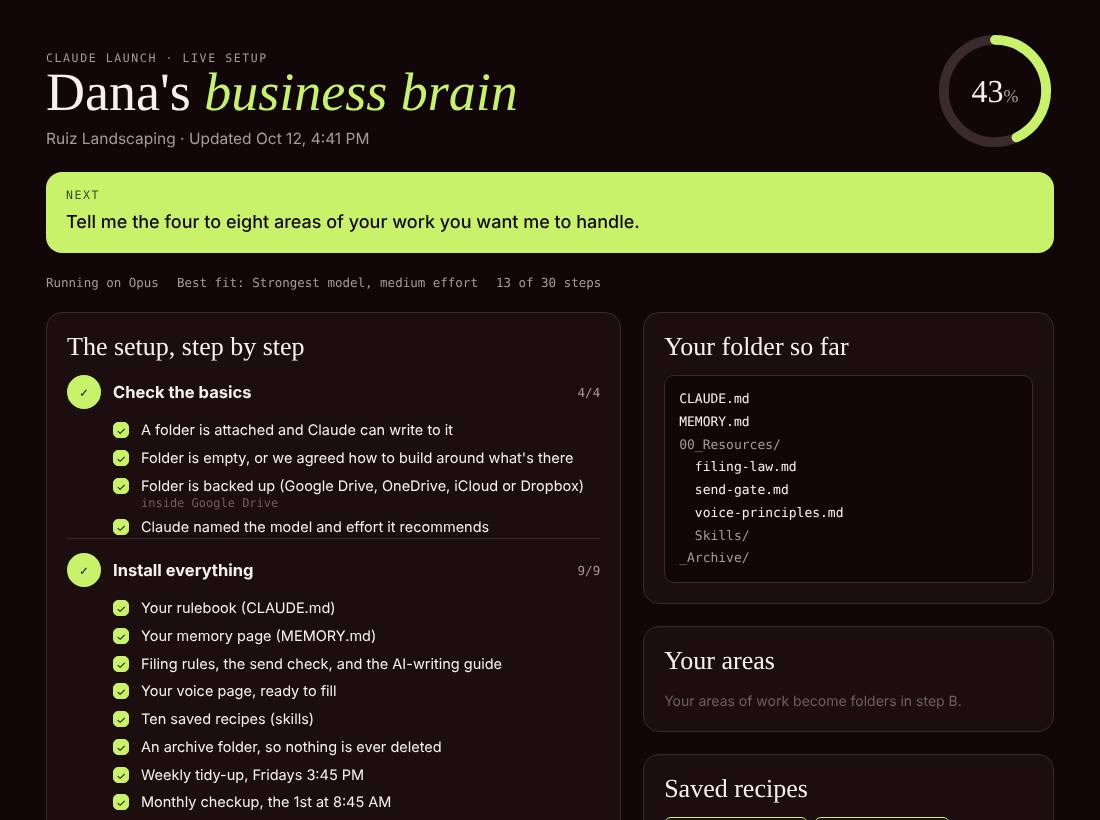
A setup checklist 43 percent done: the first two steps ticked off, the next step highlighted, and the files made so far listed
Example: partway through setting up a landscaping business.

4Stay safe

The last step checks your locks.

Letting Claude use your email and computer is like handing someone a set of keys. So setup ends with 8 safety checks. Claude does the looking and you make every call. It never asks for a password.

Only want the safety check? It works in any Claude chat
Start the safety check

It takes 30 to 45 minutes, and Claude asks before every change.

For Mac and Windows

Auto-lock

you step away15 min Claude locked out

Step away for 15 minutes and Claude loses control of your computer until you're back.

How it works

A small tool turns off Claude's screen and mouse permissions after 15 idle minutes. If the tool ever breaks, the permissions stay off, so a failure leaves you safe.

Keep it on your phone

Emergency card

Eight steps, about 10 minutes, if anything ever looks wrong.

See the steps
  1. Quit the Claude app, or turn off Wi-Fi.
  2. Switch off the Claude extension in Chrome.
  3. Log Claude out of every device.
  4. Change your email password and sign out everywhere.
  5. Unplug any app that can send or pay for you.
  6. Freeze your cards and call your bank.
  7. Check sent email and bank activity.
  8. Write down what you saw, and when.
When I ran it on myself

What it found

2old AI apps that could still send my email
90automations switched off across 6 apps
More

It also swapped my text-message login codes for an authenticator app and passkeys. After the lock was on, I asked Claude to use my computer. It couldn't.

5Day to day

Say these any time.

Once it's set up, these few phrases run the whole thing.